Memory Management Unit (MMU)
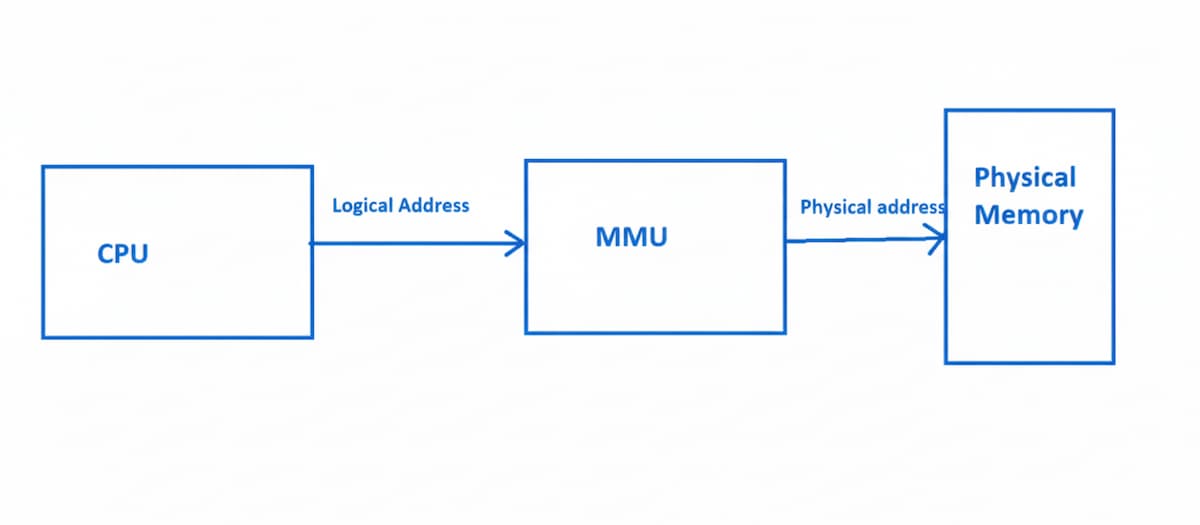
The Memory Management Unit (MMU) is a hardware component (part of the CPU or chipset) that handles address translation. It is responsible for memory management In a device as it acts as a bridge between the CPU and the RAM, which ensures that programs can run smoothly and access the required data without clashes or unauthorized access.
- It converts logical addresses (virtual addresses) generated by the CPU into physical addresses in RAM.
- The MMU ensures protection, relocation, and efficient use of memory in a multiprogramming environment.
- In modern processors (Intel, AMD, ARM, RISC-V etc), the MMU is integrated inside the microprocessor chip.
- It includes: TLB(cache for address translations), Base & limit registers, Paging & segmentation logic.
In simple words, it is responsible for memory management In a device as it acts as a bridge between the CPU and the RAM, which ensures that programs can run smoothly and access the required data without clashes or unauthorized access. It is usually integrated in the processor but in some cases it also constructed as a separate Integrated circuit (IC). It also known as PMMU (paged memory management unit).
Functions of MMU
With the growth of technology, the role of the Memory Management Unit (MMU) has become increasingly significant. It is central to address translation, memory protection, virtual memory management, and serves as the backbone of multitasking in modern operating systems. To better understand its importance, we can classify its key functions as follows:
1. Address Translation:
The primary job of MMU is to convert virtual addresses (logical addresses) generated by the CPU into their corresponding physical addresses in main memory (RAM). This address translation is essential for:
- Allowing the CPU to access the correct memory locations,
- Supporting virtual memory,
- Enabling process isolation, protection, and relocation.
2. Memory Protection:
MMUs also play a crucial role in implementing memory protection mechanisms. By implementing access control rules and regulations, they stop illegal usage of particular memory locations. By doing this, the operating system's security and data integrity are ensured.
3. Relocation:
Allows processes to be moved in memory without changing their logical addresses.
4. Paging and Segmentation Support:
MMU maintains page tables or segment tables for mapping virtual to physical addresses.
5. Efficient Memory Utilization:
Enables virtual memory, so programs can run even if they don’t fully fit in RAM.
Importance of MMU in Operating Systems:
Address Translation
- Converts logical (virtual) addresses → physical addresses.
- Allows programs to use simple logical addresses without worrying about real RAM locations.
Memory Protection
- Prevents one process from accessing another process’s memory.
- Protects the OS from user programs → ensures system security and stability.
Supports Virtual Memory
- MMU enables the use of disk space as an extension of RAM.
- Makes it possible to run large programs even if physical memory is small.
Relocation of Programs
- Programs can be loaded anywhere in memory.
- MMU maps them dynamically, so they don’t need fixed memory addresses.
Efficient Multiprogramming
- Multiple processes can run simultaneously.
- MMU manages memory sharing without conflicts.
Reduces Programmer Burden
- Programmers don’t need to worry about exact physical memory addresses.
- They write code using logical addresses, MMU handles the rest.
Performance Optimization
- By handling paging, segmentation, and caching, MMU improves memory access efficiency.
- Leads to better CPU utilization and system speed.
The MMU is the backbone of modern memory management — enabling address translation, protection, and virtual memory, without which secure and efficient multitasking operating systems would not be possible.